
Speed and Power Development: Assisted Sprints
If you put yourself inside a slingshot, would it make you faster?
Sounds ridiculous, but that’s essentially what overspeed training is trying to accomplish.
If you want to run fast, you have to experience fast. One way to experience that is from
exposure to velocities your body isn’t used to producing on its own. That’s where assisted
sprinting comes in.
Instead of waiting for your nervous system to figure it out over time, assisted sprints force the
issue. You get pulled into higher speeds faster than you could naturally reach, and your body
has to adapt.
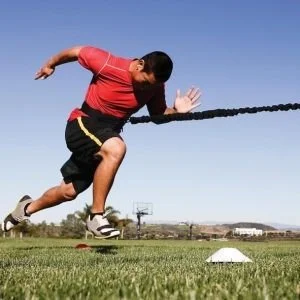
What Assisted Sprinting Actually Improves
When applied correctly, overspeed work targets specific qualities tied directly to performance:
Acceleration & First Step
You’re forced into a lot of power immediately. That teaches the body to produce force quicker right out of the gate.
Stride Rate/Turnover
Athletes can be limited by how fast they can cycle their legs, not just by how strong they are. Assisted sprints push that ceiling.
Stride Efficiency
At higher speeds, inefficiencies get exposed. The body self-organizes to keep up, improving mechanics under pressure.
Ground Contact Time
You don’t have time to sit on the ground when you're being pulled faster than normal. Contact times naturally shorten.
Neuromuscular Activation Speed
This is the real win. You’re training your nervous system to fire faster.
How to Implement Assisted Sprints
There are a few ways to get this done. Some are better than others, depending on your setup
and the athlete.
1. High-Speed Treadmill Running
Set the treadmill above the athlete’s max sprint speed and perform short bursts.
● Controlled environment
● Easy to quantify speed
● High risk if the mechanics break down or the athlete isn’t experienced
This is not beginner-friendly. One mistake and you’re off the back.
2. Downhill Sprinting
Sprint down a slight decline (think 1–3% grade, not a hill bomb).
● Simple and accessible
● Naturally increases stride frequency
● Too steep = braking mechanics and injury risk
Most people mess this up by going too steep. Then it turns into garbage mechanics instead of speed work.
3. Partner or Band-Assisted Sprints
One athlete accelerates while the other gets a delayed release, creating a “slingshot” effect.
● Best balance of control and intensity
● Easily adjustable based on band tension and timing
● Reinforces aggressive forward intent
This is usually the most practical option in a team or gym setting.
Where People Screw This Up
Let’s be clear, this isn’t something you just throw into a workout.
Common mistakes:
● Too much assistance → mechanics fall apart, no transfer
● Too much volume → nervous system fatigue, speed drops
● Using it as conditioning → completely defeats the purpose
● No baseline speed work → you’re amplifying bad mechanics
If it looks sloppy, it’s not helping.
How We Actually Use It
We don’t rely on just one method.
We alternate between:
● Assisted sprints → improve turnover, reactivity, top-end exposure
● Resisted sprints → improve force production and acceleration mechanics
That combination matters.
Assisted work teaches the body to move faster.
Resisted work teaches how to apply more force.
Together, you get athletes who:
● Start faster
● Accelerate harder
● Maintain speed longer
That’s real speed development—not just drills that look good on Instagram.
